Deliberate Practice. Are you practicing with purpose?
Here’s what I learned.
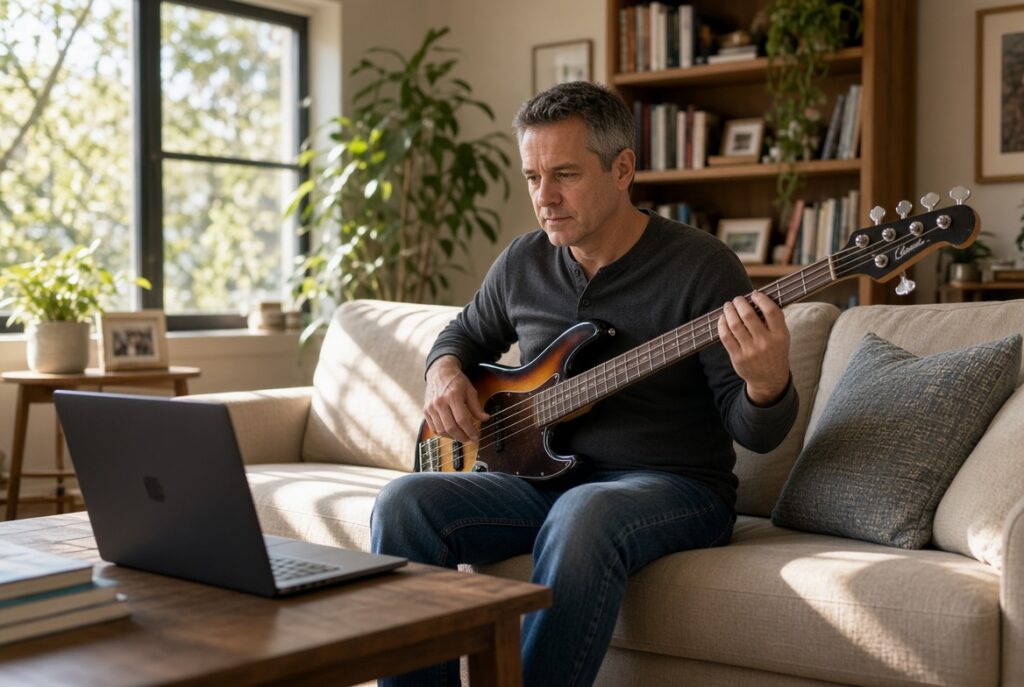
A few years back, I taught a lot of one-on-one lessons, and I had an intake form that asked about the students’ biggest struggle. Same answer, over and over: “I practice, but I don’t feel like I am getting anywhere.”
When I dug in, the pattern was consistent. They weren’t lazy; there was just a lack of deliberate practice. They were busy – practicing lots, in fact. But the practice looked like this: fifteen minutes of a YouTube slap lesson, then a chord exercise they’d seen on Instagram, then half of a song, then some random scale they’d heard was important.
None of it connected. None of it compounded.
The fact is that the algorithm is not your friend here. It’s optimized to keep you watching, not to build your bass playing. Every new video feels productive. Most of it is edutainment – the flashier the better – creating a dangerous illusion of actually practicing.
What actually works is less exciting to describe but more satisfying to do. Real understanding of what you’re playing. Technique that’s rooted in your body, not forced. Rhythm that lives in you, not just on a metronome. Ear training that connects what you hear to what your hands do. A fretboard that starts to make sense. None of it is a hack. All of it compounds.
The players who make real progress aren’t practicing more. They’re practicing less stuff, more deliberately.
⚡️ Deliberate Practice Spark
Take a short section of a bass line that’s giving you trouble. Video record yourself playing it with a click. Listen back and ask yourself, what am I actually hearing?
- Dropping beats? Unsure of barlines, accents, rests? That’s a rhythm problem.
- Shoulders by your ears, holding your breath, over-gripping, rushing, uneven notes? That’s a technique problem.
- Not sure what the notes mean in the bigger picture – the key, the chord, what would work as a variation? That’s an understanding problem.
- Can’t tell right notes from wrong ones, hitting clams when you try to vary? That’s an ear problem.
Here’s the thing: just being able to name which symptom you have is huge!
It turns confusion into a direction. You stop poking around. You become your own coach because once you know the problem, you can apply a fix! So, be kind to yourself; you are Sherlock on a mission!
Quick fixes by category:
Rhythm: Put the bass down and chant the rhythm. Or play it on one note, no other pitches. Listen to the original and move your body side to side to mark the beats.
Technique: Play the line again, but this time softly. Think: no big deal. Scan for tension, breathe into it. Let go of extra movement.
Understanding: Analyze what you’re playing. What are the scale degrees over each chord? Play just the roots. Then outline the chords. Then look at what the line actually does.
Ears: Hit a clam on purpose. Hear the difference between wrong and right. That contrast is the lesson.
Most of the time it comes down to slowing down, breathing, and thinking. Stress gets in the way more than ability does.
👉 Want to practice this way with me, live, every week? Join Live Practice and come work on your playing in real time while getting feedback.
Check the other two articles in this series:
- How to play with less tension (Part 1 of 3)
- Gear talk can wait (Part 3 of 3)