My marketing team reviewed my Starting Point Quiz this week.
Their feedback?
“It’s too academic.”
“Lead with pain points.”
“Make it lighter.”
They’re not wrong.
I could write you a quiz about:
- your frustration with tabs
- your YouTube rabbit holes
- that feeling of “I know the notes… but I can’t make it groove”
You’ve seen that quiz before.
But here’s the issue:
That kind of quiz quietly suggests your frustration can be fixed without dealing with the underlying skills.
And that’s the part that would be a lie.
Because if you want to actually get good – fluid across the fretboard, confident, able to create instead of copy – there are a few things you can’t skip:
- You need to know where the notes are on the fretboard.
- You need to understand what a chord like Db7 actually contains.
- You need to map sixteenths notes against a subdivision grid to make it groove.
Not because it’s “academic.”
Because that’s what the music demands.
If those pieces are missing, no amount of tips, tricks, or “groove hacks” will hold things together for long.
That’s why it feels like you’re circling the same problems.
So, I’m not going to pretend the path is something else.
What I can do is make those fundamentals click in a musical way – so they actually show up when you play.
So, no – I’m not turning the quiz into a fluffy personality test.
I’d rather be honest about what it takes, and actually help you get there.
And if you’re the kind of player who wants to understand what you’re doing – not just memorize shapes – you’ll feel at home here.
 Practice Spark (Notefinder – 2 minutes)
Pick one note. Let’s make it Eb.
Find it once on each string—E, A, D, G (in that order).
(This is part of the Notefinder drill we use throughout the Theory course.)
From each note, play a major triad.
Bonus 1: Use the second finger or the pinky as your starting points for this.
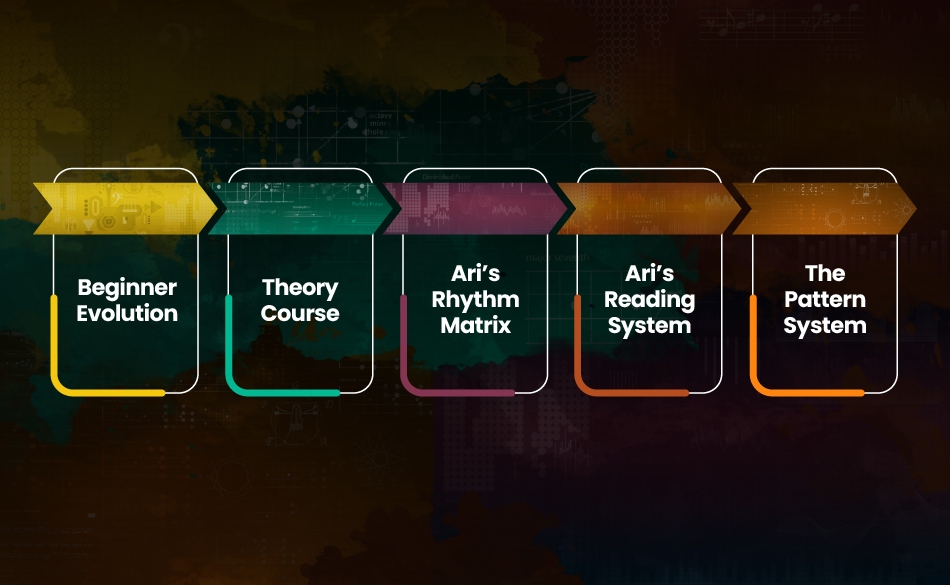
Bonus 2: use all available notes of the triad (Eb G Bb) in the position you are in; that way, you naturally get the five triad shapes of the Pattern System. It’s quite magical. Those five shapes? Learn them super well!
 Bass Question of the Day
“Do I really need to learn note names and chords to get better? Can’t I just learn songs?”
You can just learn songs – and if that’s your goal, that’s completely fine.
But songs alone won’t teach you how to
- create your own bass lines,
- move freely across the neck,
- nail tough syncopations freely,
- or play confidently in different keys.
For that, you need to understand what the song is made of:
the notes, the chord tones, the relationships on the fretboard.
Songs are a great entry point.
But if you stop there, you stay dependent on tabs and memorized shapes.
A better approach is, to not just learn songs – but learn from them, and use them to build the fundamentals that make everything else possible. I like using songs in our Live Practice with Ari sessions. I take a riff or line and work it through the cycle for example. Or I take a bass line and we create fills using a certain theory shape. That sort of thing makes it applicable.