Powerful Bass Practice Drills That Actually Work!
In our courses, you’ll be asked to chant words, scat a solo, move your body, feel upbeats and downbeats in specific ways.
- You’ll practice without touching the bass
- Visualize shapes
- Hear lines internally
- Feel subdivisions inside the click. Straight and shuffled.
We’ll talk about emotions in ear training, from “love-song-stuff” to “murderer-about-to-come-round-the-corner”- sounds.
We’ll make you drop your hand mid-phrase.
We’ll name shapes things like “Big Box/Little Box”, “Little Box/Big Box” or “The Boot”.
None of this looks like practice. Yet it is. And very powerful practice at that.
What most think practice means
Most players think practice means fingers on strings, playing songs. Repetition. Time served.
But when someone gets “really good,” what actually happened?
• They built internal maps of the fretboard.
• They hear before they play.
• They feel time and groove without chasing it or leaning on anyone else.
• They intuit theory and how harmony moves.
Some heroes love to state that “they never studied theory” or “they never used a metronome.”
Yet they built such incredible skills!
Is it all just talent? Or is theory and the metronome somehow the problem?
No.
It’s not magic.
Not talent.
And not a free pass to skip theory class.
It’s a specific kind of practice. Usually the kind that started very early in life, often with guidance and lots of exposure. That way they built skills so deep and effortless that they became unconscious.
That’s why it feels like they “just picked it up.” Without ever using a metronome or an eartraining app or studying theory formally.
So what if you didn’t have that at age six?
Is it too late?
No!
That’s where the “weird drills” come in.
They bridge the gap between complex musical skills and the kind of unconscious fluency those players developed early. And they accelerate the process.
If this sounds abstract, here are a few concrete examples:
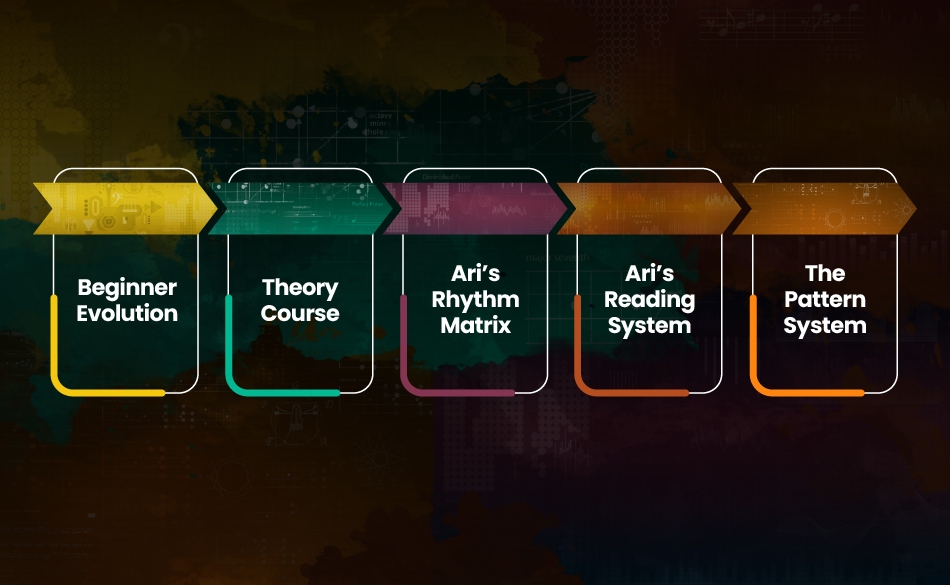
• Complex rhythm? Say weedwhacker. (The Rhythm Matrix).
• Major pentatonic scale? “Little Box Big Box Shape”.
• Thirds and their inversions, the sixths? Love song stuff.
• Key of the song? That “coming home” feeling at the end.
• Groove? Erase the click through claps and hear the subdivision internally.
Practicing like this speeds everything up. Especially if you didn’t start at age six.
And it works.
There’s only one catch: you have to actually do it.
It’s easy to want to skip it because it feels awkward. Or pointless. Or not like “real practice.”
The Take Away
Do the weird stuff. It works.
A few focused minutes go a long way.
You might also like these practice tips: