How Many Notes Are There?
In the movie Amadeus, the Austrian Emperor Joseph II says to Mozart – as the last notes of the opera he had commissioned the young composer to write: “Mozart, this piece of music has too many notes in it!” And Mozart answers: “Exactly as many as necessary, your Majesty!” (good story, and yes, there is the artistic aspect of how many notes there should or should not be, but that is not what I mean here).
I am talking about note names.
What is Your Guess?
12? In a way that is correct – there are 12 enharmonic notes. They form the chromatic scale, which is a scale made up of all half steps, thereby sounding all available notes.
Not quite what I was looking for, though.
88 on the piano? And however many frets my bass has times however many strings my bass has?
Yes, okay, but that would be individual pitches! That answer would point towards the “range” of an instrument.
Still not what I am fishing for.
What I mean here are individual note names. They sound the same, but are enharmonically different. Enharmonic means that they can have different names, yet sound the same.
And most notes can have more than one name.
So you could sit down at the piano and figure it out. Black keys all have two names, and then the F can be called E# and the E can be called Fb… you can count that way and would probably get there. But you could also take a drastic shortcut to the entire exercise…
And then the answer is 21.
Why?
- letters (naturals): 7
- sharp (#) them all: 7
- flat (b) them all: 7
Sum : 21
(#s raise a note by a half step. bs lower a note by a half step. On the piano that sometimes leads to a black key, for example C#, but not always, for example E# is a white key).
I recommend you now check out a piano and find them all. The piano is so visual and color coded, it helps understanding. Many musicians think a # or b always amounts to a black key on the piano. Of course that is not so: Cb is a white key (AKA the note B)
And then find them all on the bass, like this:
- first all naturals
- now all sharps
- now all flats
More tips on how to practice this:
- Say the note names out loud as you do this.
- Practice on each individual string,
- Then also try to stay within a five-fret span.
- Do this ascending and descending
It is a great exercise in understanding how
- notes relate
- and how the bass works
The graphic below is clickable for download.
But wait, there is more:
There really are even more notes if you figure in x (double sharps) and bb (double flats).
- A Cx would enharmonically be a D for example,
- or an Fbb would sound the same as an Eb
If you count them as well you get 14 more. That’s 35! Whew!
Music theory dictates when to use #s, xs, bs, bbs or naturals, where possible. There are actually instances where thinking about a x or bb may be more logical and hence easier. For example: Take a C#7#11 chord (that’s a chord that is contained in a scale called lydian dominant, and it is the 4th mode of G# melodic minor): C# #11 shows up, for example, you’d end up with an Fx (easier to think about rather than a G, that would be an odd scale:
not: C# – D# – E# – G – G# – A# – B – C#
but: C# – D# – E# – Fx – G# – A# – B – C#
etc. – if that last paragraph has you confused, don’t worry about it. Just know that sometimes it matters for good reason to go through the trouble to double up!
I suggest you go ahead and find the doubles as well! It really is great practice for them brain muscles – it will illuminate your understanding of how notes relate!
Enjoy! As always, I welcome your comments.
Ari
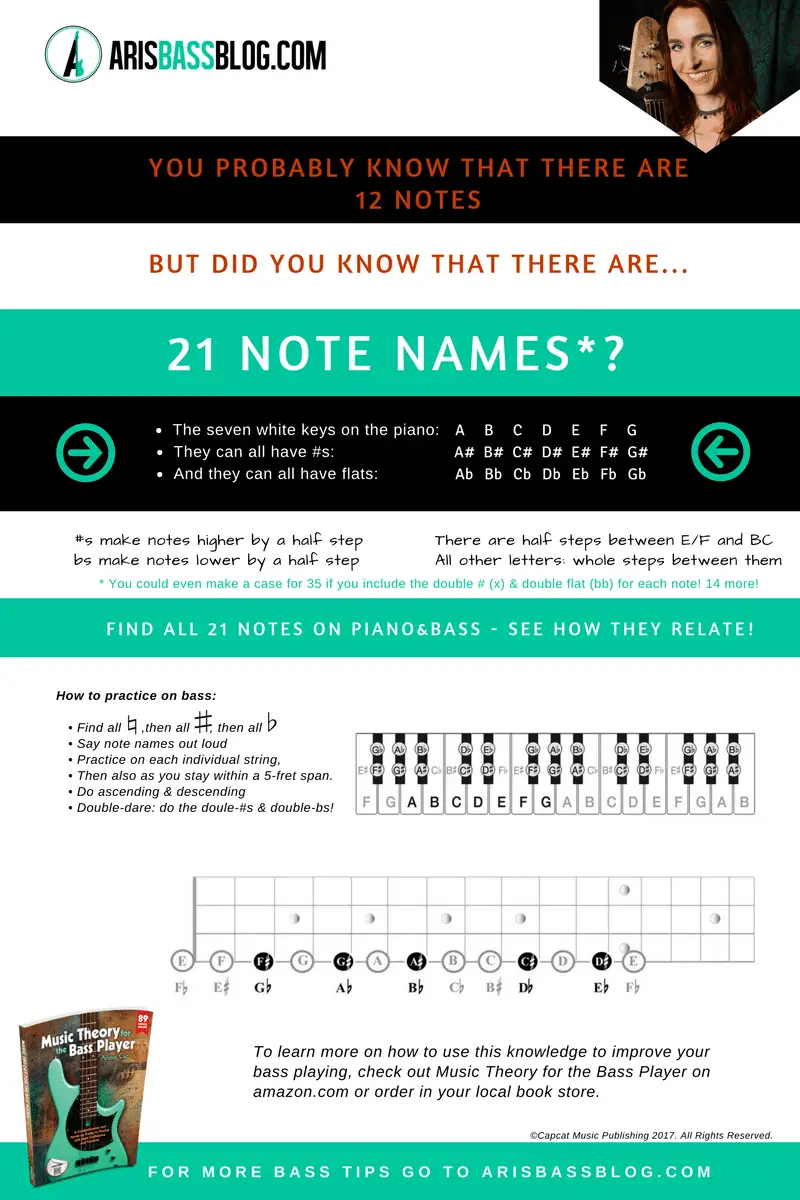
How many note names are there? 35 🙂