The Natural Minor Scale
Now that we have looked at my ultimate shortcuts for the major scale, look at the minor scale.
Make sure to check out this blog post on notes as well as this one on the major scale, in case you missed these posts.
Major and minor scales are related! Start a major scale on the sixth scale degree and declare that note the root – there is the relative minor. Relative scales share the same key signature (ie accidentals, ie notes, the same seven notes!), but they start on different notes. Take a look at the info guide below for a super useful shortcut on the bass – how major and minor scales are related!
My shortcut methods are much preferable to the usual WHWWHWW (which is the formula for minor. If you are looking for major go here). Points I made for the major scale hold true for the minor as well. Here they are:
Knowing scales is super useful for
- reading sheetmusic (it is much easier if you know scales and know how to play them on the fretboard! Learn theory first, then reading)
- memorization
- song analysis
- communication
- your creativity (bass line creation)
Here again is why I don’t promote WHWWHWW.
- Miscounting is prevalent
- You need the notes under your fingers immediately, not after cumbersome counting
- With this method of counting it is necessary to start from the top of the scale each time to know if a note is part of a scale or not
- Counting whole steps and half steps will not tell you anything about the names of notes
- Half step counting is not very effective when descending in the scale or improvising within it
- W and H does not tell you anything about how individual notes will sound within the context of a scale
My Recommendation is…
- to think of the notes in the scale as intervals with the root.
- That way you arrive at a usable pattern on the fretboard – a shape you are playing with your fingers. (This is why knowing intervals is so useful!)
- Each note is now accessible to you for improvisation – in the context of the scale!
- Knowing a scale that way also allows you to make judgments about the sound of each note within it before you even hear the note.
- to name notes correctly according to the formulas on the graph, because…
- it helps communication
- it shows you the inherent logic of the 7-note minor scale
- it ensures that you don’t end up creating more accidentals than necessary (Avoiding double sharps and double flats)
- it is almost faster than having the cycle of fifths under your belt (which – while important – does not click for some people while they could use scales very effectively)
Without further ado: enjoy my famous short cuts to minor scale mastery. I am also adding a few sample scales below the helpful graph. Then you try a few!
Apply the rules 1 – 2 – 3 and you can never go wrong.
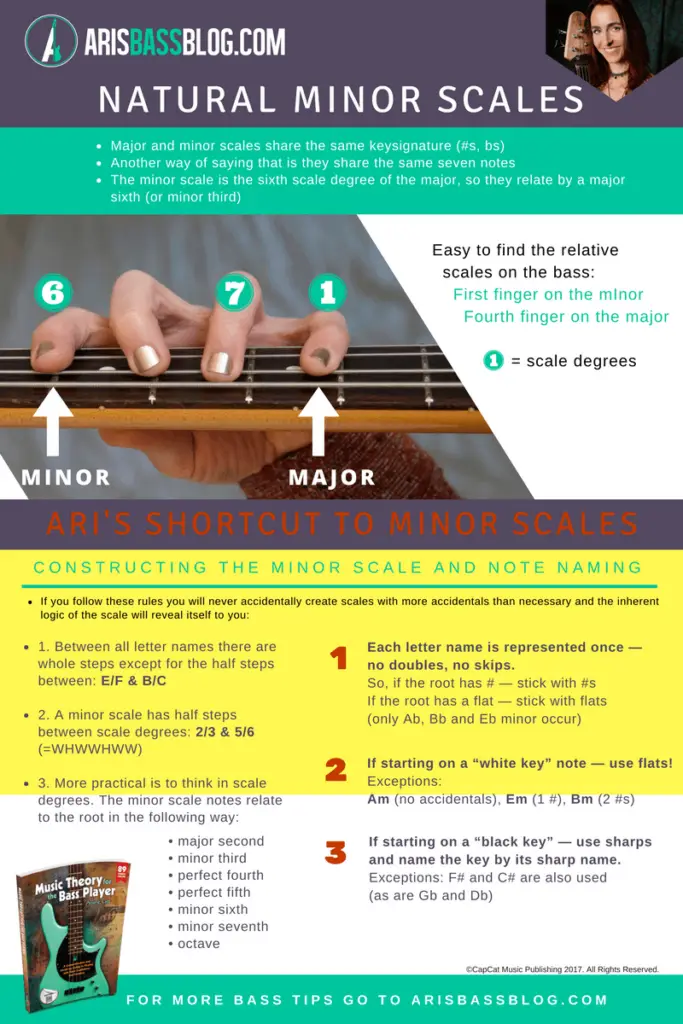
To download the above image, pull it into your downloads folder or right-click and save!
To get more shortcuts and in-depth materials –
please check out my book, Music Theory for the Bass Player