Strapped for answers about strap length?
How low can you go?
Down Low for Maximum Cool Factor
Picture this:
Headbanging on stage, the bassist pounding the strings hard – sometimes with his fist – he’s loving it and the audience is feeling it! The bass hangs low – so low you can barely see his knees. His left hand clenches the bass with a fist most of the times. It’s an impressive display of raw energy and who wouldn’t want some of that for themselves!
High up for comfort
Then you go next door where a fusion band is playing. No light show, no hair flying. It’s a high energy of a different kind: Blindingly fast runs – in unison and sometimes interlocked. The bassist flies all over the fretboard seemingly having four hands with 10 fingers each! She plays chords, intricate grooves, solos and just watching the finger acrobatics makes you weary (even though it looks all so effortless!).
And her bass is held high close to her chin – or so it seems!
So, what’s going on here?
Why such a difference in strap length, (ie, how high/low the bass hangs)? I think the above scenarios pretty much give it away already. The demands on each player are vastly different in these situations. I deliberately created two extremes. Both are musically great. I don’t see one superior over the other. They just have different goals and accordingly different means of achieving them.
Heavy Rock: you better move around on stage, and at the very least: headbang.
Fusion: no one cares about your moves: the audience is focused on the music and immersed in the intricacies of the lines rather than the raw power of the riff and the “show”.
Fusion music is typically more complicated to play (although that is not always true. modern metal bands often do very involved stuff). The bass needs to be in a position where the fingers have maximum flexibility to execute various playing techniques like:
• Scale runs including chromatics – more challenging to play than pentatonics (again, I’m over-simplifying the comparison for demonstration purposes)
• Chord voicings that go far beyond triads or 1-5-8
• Groove lines that change often, require frequent changes of position, combinations of scalar patterns, stretch positions, double stops, chromatics
All very difficult and often downright impossible to execute when the bass is hanging very low.
How Low is Low?
As a ballpark guide, I consider it a low position (long strap length) when the left hand operates lower than your belt line.
It is at that point that you observe the following changes in your right arm:
- The right arm can no longer fully rest on the bass which results in
- an almost straight wrist!
- the necessity to pull up the right arm or shoulder (which can lead to pain in the shoulder blades)
- As a result of this, you get less help for the left-hand thumb (when your right arm rests on the bass, it stabilizes the neck and mitigates the danger of overgripping in the left hand (ie, overworking the thumb by squeezing the neck)
- the need to adjust slapping or thumping techniques (a low position necessitates coming to the strings from above and with an up-down motion with the right arm rather than coming from slightly below the string and flicking the thumb out with a twist of the wrist)
- The right hand cannot easily pluck chords.
It is at this point that you observe the angle of the left arm and hand changes:
- Stretching the left hand fingers over 4 frets becomes difficult.
So what are you to do?
Experiment.
Higher – easier to play.
Lower (longer strap length) – potentially higher coolness factor.
It really comes down to “How low can you go?” without sacrificing playing quality. Looking cool won’t matter much if your playing suffers.
What I do
I am very comfortable playing seated on a drum stool with my bass resting on the right leg. I aim to be completely symmetric, not twisted. This is the perfect length for me. My strap is set so that whether I sit or whether I stand, my bass hangs in almost the same position.
Bonus Tip: a wide, soft strap is always of great help! My favorite is the Scott’s Bass Lessons strap! It is wide and soft and super comfy!
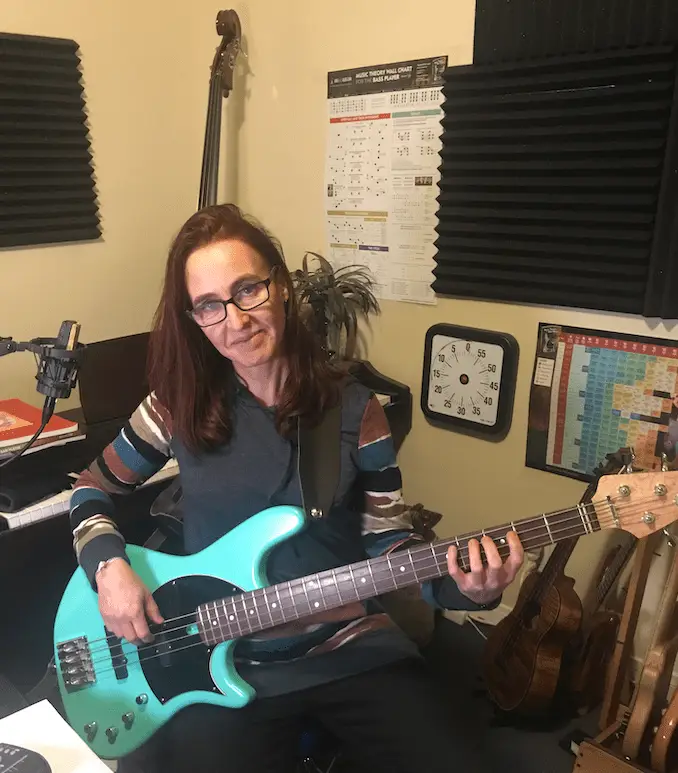
Seated, bass resting on the right leg
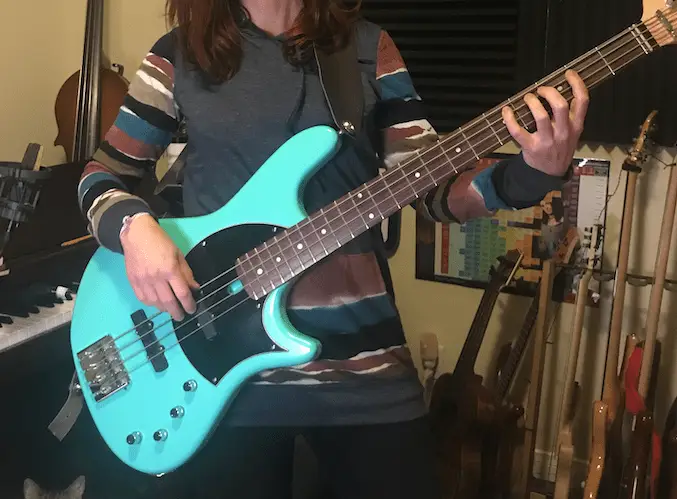
Standing, neck comes up a little but otherwise same distances
Bass Basics: Three Ways to Tune a Bass
Seated Posture – Classical Guitar style?
For optimal technique training, check out my Course, Music Theory for the Bass Player