My Gear:
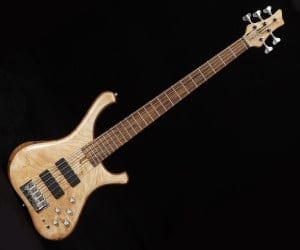
- I use Marleaux Basses and Dean Markley Strings.
- TC Electronics Pedals, cabs and amps
- Fretwrap by Gruvgear.
(Ariane Cap is an official endorser for all these fine companies.)
Thanks to Wolftrackaudio.com for audio post production.
Another good “Bass Bit”: The Range of the Bass
Transcript:
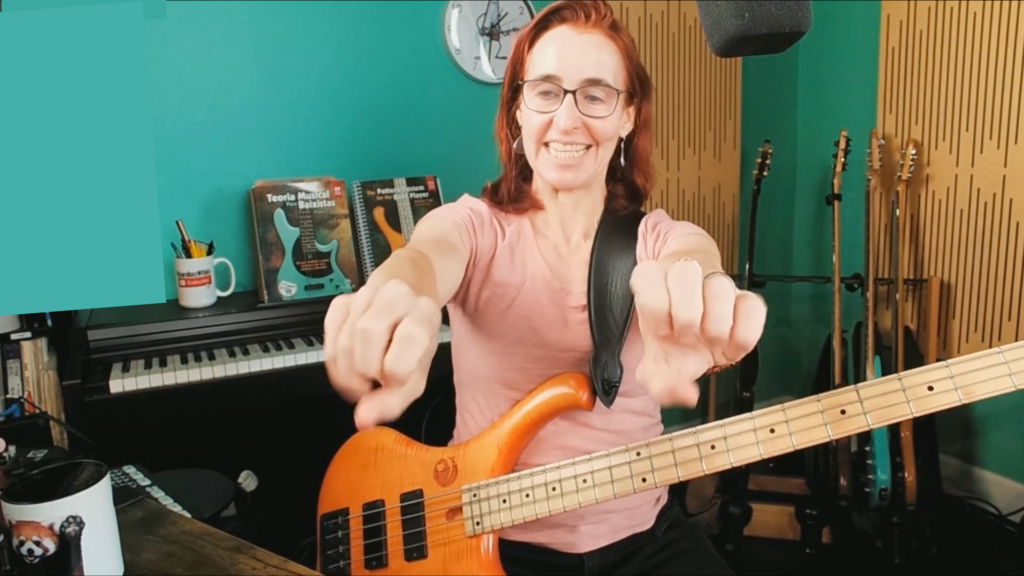
Hello! Welcome to Bass Bit #5! Today is all about connecting the dots – the dots on the fret board that is. Obviously, they are there for orientation. Some basses start with their first dots right here on the first fret. Most basses start on the third fret, and then it’s usually third, fifth, seventh, ninth, and then two dots on top that mark the octave. Now some basses have twenty-four frets so this whole thing will repeat. Some have a few less than that, some even have a few more than that but basically the pattern will always repeat and help you orient yourself and find your notes and here’s a great exercise for you.
It’s one of those exercises you can do away from the bass or you can do it just sort of at random times during the day – every time you walk by your bass, or walk through the room, or go to the bathroom or something like that. It takes not even a minute and it has a truly great effect. So here’s how it works. You pick a dot and you pick a direction. Let’s say, I’m going to go up. I’m starting ascending and then descend and I’m going to pick the first dot. I’m just going to demonstrate that on all the dots. I like to set a tempo, as always, as it helps to ensure that you are consistent. And if you want, in the beginning, you may want to have a couple of beats go by. Like [playing: 1.31] G…[playing: 1.33] C… think about what’s next… [playing: 1.35] F…[playing: 1.37] Bb…
Or you can just go: [playing: 1.39 to 1.42] Bb – F – C – G…
Could I say that using sharps? Yes I can: [playing: 1.45 to1.51] G – C – F – A#; A# – F – C – G.
I could even do this: [playing: 1.53 to 1.58] G – C – E# – A# – E# – C – G.
I could even do this: [playing 1.858 to 2.04] G – B# – E# – A# – E# – B# – G.
So you get the idea. I could even do this: [playing: 2.07 to 2.12] Fx – B# – E# – A# – E# – B# – Fx. Alright, now, since I can do that, I can do the same thing with flats:
[playing 2.16 to 2.23] Abb – Dbb – Gbb – Cbb; Cbb – Gbb – Dbb – Abb.
Kind of a brain twizzler, but again, it helps to understand how music and the bass is organized. So let’s go dot by dot and do this mental twisting exercise. Here we go:
[playing 2.35 to 2.47] A – D – G – C; C – G – D – A ;
Gx – Cx – Fx – D#; D# – Fx – Cx – Gx.
Now, the double flat. How about that?
[playing 2.51 to 2.58] Bbb – Ebb – Abb – Dbb; Dbb – Abb – Ebb – Bbb.
Next stop: [playing 3.02 to 3.14] B – E – A – D – D – A – E – B; – Ax – Dx – Cx – Cx – Gx – Dx –Ax.
Flats: [playing: 3.16 to 3.22] Cb – Fb – Bbb – Ebb; Ebb – Bbb –Fb – Cb.
Next stop: [playing 3.27 to 3.40] C# – F# – B – E; E – B – F# – C# (also known as Db, Gb). And then Cb and Fb if you want: F – Cb – Gb – Db.
And then we can do this whole thing with double sharps: [playing 3.47 to 3.53] Bx – Ex – Ax – Dx; Dx – Ax – Ex – Bx.
Mind bender!!
Db: [playing 3.58 to 4.04] Db – Gb – Cb – Fb; Fb – Cb –Gb –Db. That was not that hard as they are all single flats.
And we have the double dots: [playing: 4.10 to 4.22] E – A – D – G; (just like the open strings) G – D – A – E. Or, Dx – Gx – Cx – Fx; Fx – Cx – Gx – Dx.
And, we have the flats on this one here: [playing: 4.28 to 4.34] Fb – Bbb – Ebb – Abb; Abb – Ebb – Bbb – Fb.
So you can see, this is quite some mental acrobatics! But it helps you think about the bass in different ways, helps you shed the notes even if you don’t have the bass at hand. I think it’s a great exercise. And once we know the dots, obviously you’ll get faster and faster and faster in deducting where all the notes in between are. If you know this is a [playing: 4.52] C, that’s a [playing: 4.53] C#. If we think about double flats, flats and sharps and so forth a lot, we’ll get really fast in doing this and it’s useful.
So, enjoy! Let me know what kind of results you’re getting. Please comment. Let me know how it’s going. If you have any questions, you can find me at the Contact Me link. Alright, thanks for watching.
If you’d like to study with me, click here.